.png)
 1 hour ago
1
News india India Sees Third Warmest October Since 1901, Record-Breaking Day Temperatures Amid Strong El Niño
Last Updated:November 01, 2026, 11:23 IST
With an average monthly temperature of 26.6°C, nearly 0.94°C above normal, this October was third-warmest on record, surpassed only by 2024 and 1951


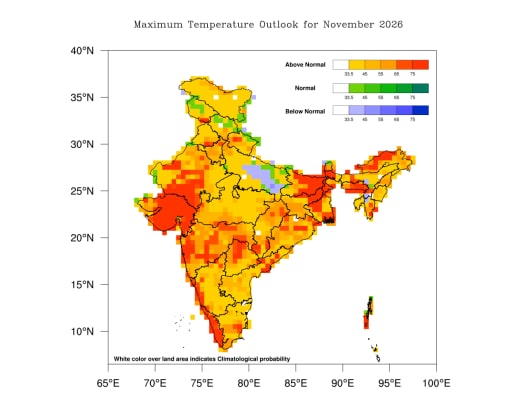
The IMD has predicted day and night temperatures in November to be above-normal as well, except for some parts of J&K, Uttar Pradesh and Himachal Pradesh. (Image: PTI)
The impact of a strong El Niño continues to be felt across India, with the MeT stating that average day-time temperatures in October broke an all-time record for the month surging to nearly 32.4 degrees Celsius – 1.06 degrees Celsius warmer than normal, and highest since 1901.
India experienced above-normal day and night temperatures during the month, which ended as the third-warmest after 2024 and 1951. The average monthly temperature stood at 26.6 degrees Celsius, nearly 0.94 degrees Celsius above normal.
The warming was more pronounced in the southern peninsula, where both average day and night temperatures were highest since 1901. Data shows that the southern peninsula recorded its five warmest Octobers in the last 15 years.
“We are witnessing warmer years especially after 2001. Both maximum and mean temperatures are soaring to record-breaking extremes in recent decades. But, the warming this year is also due to a strong El Niño that prevails," said India Meteorological Department chief Dr Mrityunjay Mohapatra.
This comes in the backdrop of an intensifying El Niño – a global ocean phenomenon characterised by above-normal sea-surface temperatures in the equatorial Pacific Ocean.
“A very strong El Niño prevails, and it is likely to gain more strength and eventually peak in November. After that, its intensity will start decreasing but the winters will continue under El Niño conditions, which are expected to last until spring next year," Mohapatra said.
October also ended with a rainfall deficit of nearly 31 per cent below the long-term average, despite the heavy rain spell brought by the western disturbances as well as very severe cyclonic storm ‘Arnab’ that hit the Andhra Pradesh coast on October 28, and moved northwestwards towards Chhattisgarh and Uttar Pradesh.
The IMD has predicted day and night temperatures in November to be above-normal as well, except for some parts of Jammu and Kashmir, Uttar Pradesh, as well as Himachal Pradesh where they may drop to below-normal. The monthly rainfall is also likely to be below-normal.
ANOTHER CYCLONE TO HIT ANDHRA COAST
The weather department also issued an alert for another cyclone brewing in the Bay of Bengal, which is likely to make landfall over the southern Andhra coast during the early hours of November 3 at a speed of 80 to 90 kmph.
It is likely to bring extremely heavy rainfall over Andhra Pradesh coast as well as Odisha in the coming days, with fishermen advised not to venture into the sea.
Normally, four to five tropical cyclones form in the Indian Ocean during a year; however, this year, there were none in the pre-monsoon season. Cyclone ‘Arnab’ was the first to form in the post-monsoon season, followed by the latest, which is set to be named ‘Murasu’.
“We normally see less number of cyclones during El Niño years, and their intensity is also subdued. They usually make impacts over the coast of Andhra Pradesh and Tamil Nadu, occasionally Sri Lanka as well. Since this is an El Niño year, we have seen just two cyclones so far," he Mohapatra said.
Handpicked stories, in your inbox
A newsletter with the best of our journalism
Quick Answers
Powered by
 Ask News18
India experienced its third-warmest October since 1901 due to a strong El Niño phenomenon, with average day-time temperatures reaching nearly 32.4 degrees Celsius.
The weather department issued an alert for a brewing cyclone in the Bay of Bengal, set to be named 'Murasu', which is likely to make landfall over the southern Andhra coast during the early hours of November 3.
October ended with a rainfall deficit of approximately 31 per cent below the long-term average, despite heavy rain spells from western disturbances and cyclone 'Arnab'.
Powered by
Ask News18
About the Author

Srishti ChoudharyAssociate Editor
Srishti Choudhary, Associate Editor at CNN-News18 specializes in science, environment, and climate change reporting. With over a decade of extensive field experience, she has brought incisive ground r...Read More
First Published:
November 01, 2026, 11:23 IST
Disclaimer: Comments reflect users’ views, not News18’s. Please keep discussions respectful and constructive. Abusive, defamatory, or illegal comments will be removed. News18 may disable any comment at its discretion. By posting, you agree to our Terms of Use and Privacy Policy.
Read More





 English (US) ·