.png)
Those little holes play more of a role in making the plug than they do in your home’s wall outlets
anmbph/Shutterstock
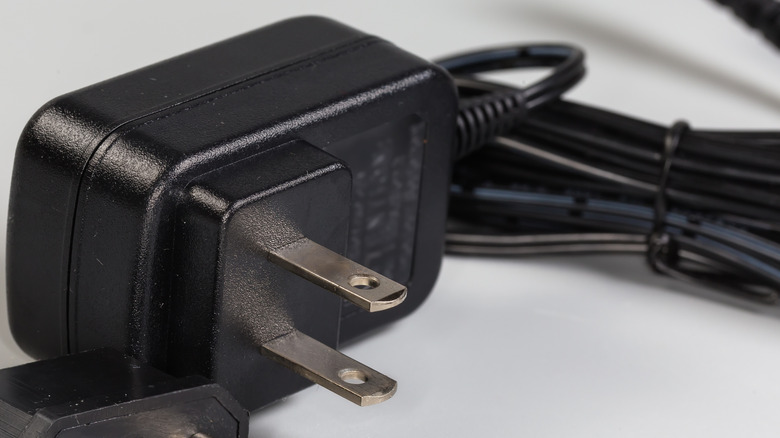
Of all the things in the world to sit back and contemplate, holes in electrical plug prongs are one of those great mysteries. It's right up there with the hollow moon theory and underground military bases in Antarctica. Not really. The truth is, while these enigmatic holes once served an everyday purpose (more on that below), they are mainly useful in the manufacturing process today. They help manufacturers position the metal blades during manufacturing, but they aren't openings for electrical current or portals to another dimension.
Basically, a worker passes an alignment rod through the holes to hold the blades in position before plastic is molded around the assembly. The holes also serve as lockout tags, a necessary safety mechanism. A once sensible purpose in the home is now a holding, positioning and locking convenience for manufacturers. It's a simple way to keep components correctly aligned during production. That goes for ordinary plugs on a vacuum cleaner to smart plugs for smart home integration (just don't plug a power strip into your smart plug).
Of course, not every manufacturer uses the same process. It does answer the "why" of today's perforated plug prongs (say that three times really fast!), a feature that doesn't need to perform a specific job in your outlet, but is still useful in a factory.
The outlet-gripping explanation has a history
You've probably come across the "holes help an outlet grip the plug" explanation. It's a sensible answer that's no longer grounded in reality. According to the National Electrical Manufacturers Association (NEMA), the holes originally worked with a small raised feature inside the receptacle. That feature basically clicked into the hole to help retain the plug. The mechanism is known as a "detent."
Detents still have uses outside of ordinary household electrical plugs, but that deserves its own, separate article. Later, Underwriters Laboratories (UL) revised the standards on receptacles to hold plugs in place without the holes. Those requirements also limited how difficult a plug can be to remove, with a different test gauge that didn't have holes. Most manufacturers stopped adding the matching raised features because they did nothing to help meet minimum requirements and made the plugs more difficult to withdraw.
The detent design in wall outlets went away accordingly, but the holes in plug blades did not, leaving the design feature entirely optional, with most manufacturers continuing to use them. Outlets are now designed to hold the blades in place, and the holes are still compatible with older receptacles. It works either way, whether your household receptacles are ancient or just installed yesterday.
Can I use a plug without holes?
JACKREZNOR/Shutterstock
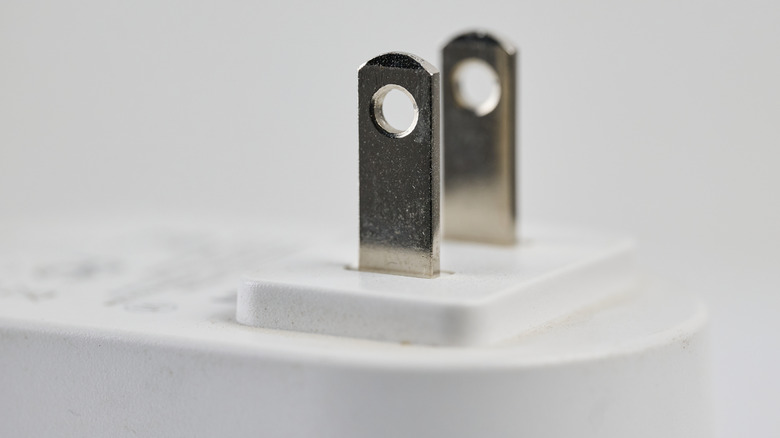
You sure can. A plug without any holes isn't defective or anything, and it's not missing the required safety features, though some plugs, like extension cords, shouldn't be plugged in at all times for safety. If a manufacturer produces a plug with holes, it has to follow the specified size and lead-in shape to maintain compatibility with old and new receptacles. The burden is on the manufacturer, not the buyer.
A solid, hole-free blade will still make electrical contact and close the circuit in an appropriate outlet (including those with retractable prongs). Older receptacles use the detent, and newer receptacles must meet the minimum requirements for plugs without holes. Either way, you're good to go.
The only practical concern you have to worry about is the condition of the connection. If your plug is sliding back out with little resistance, it's probably wear and tear in the receptacle, not the plug prongs. You don't need to go out and hunt for a plug with holes. Instead, go find a new receptacle. Changing them out isn't too difficult; just make sure the power is cut off at the breaker. Fingertips and 15 to 20 amps don't mix well. Also, don't drill holes in the prongs if you have a plug with solid blades. The holes really aren't necessary.






 English (US) ·