.png)
 29 minutes ago
1
Dubbed the “Opera House of western Sydney”, Powerhouse Parramatta’s white lattice exoskeleton, composed from 1,300 individual pieces and wrapping 30,000 sq metres of interior space, has already become a familiar landmark.
Even better known, perhaps, is the project’s controversial history. Since the Parramatta outpost was announced in 2014, a vocal group of dissenters led by former staff and trustees has lamented what they see as the neglect of the museum’s Ultimo site in favour of a new infrastructure project, and what they say is a shift away from the museum’s core business towards contemporary art and events.
The eye-watering price tag – $915m, in an era of funding precarity for the arts – has also come under scrutiny, culminating in a New South Wales Treasury investigation into allegations over the museum’s governance and procurement practices. In late August, 10 weeks from the scheduled opening, CEO Lisa Havilah was stood down while the investigation unfolded.
When the major new venue opens to the public on Saturday, the big question will be: was it worth it? What will it bring to Parramatta – and will it be enough to bring the rest of Sydney, and the rest of Australia, out west?
Powerhouse is sweetening the pot with a 23-day opening festival of performances, parties, talks, screenings and workshops, with 65% of the program free. When Guardian Australia visited last week, the space was crowded with installation crew in hi-vis, hard hats and steel-capped boots. But even with its exhibitions in various states of readiness, it was hard not to be dazzled.
Dizzying spectacles and a sense of calm
The steel exoskeleton that has been such a prominent addition to Parramatta’s skyline is more than decorative. Encasing two towers, and built from 12,000 tonnes of steel, it’s what allows the building to boast massive column-free exhibition spaces up to 18m in height, including the largest in Australia.
But at first encounter, perhaps the most striking thing about the Moreau Kusunoki and Genton-designed building is the sense of calm it evokes. This is a building that is constantly calling you to slow down, take a breath and look beyond its architecture to the city, landscape and Parramatta River below.
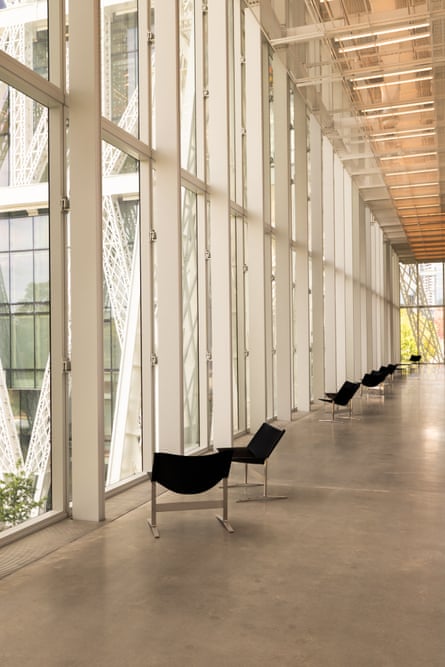
The glass facade and abundance of natural light is complemented by an airy colour palette, all creams, white and light greys – including interior walls covered in a pale, textured render made from 600,000 crushed oyster shells, locally and sustainably sourced. Wide corridors flanking the exhibition spaces are lined with chairs and lounges that invite you to pause and take in the view.
This peace is particularly necessary given the dizzying spectacles of Powerhouse Parramatta’s five opening exhibitions – including a tribute to space and flight; a celebration of the shopping mall; a kids’ exhibition themed around the dark; and a showcase of British designer Es Devlin – which otherwise risk sensory overload.
Coups de théâtre abound: secret doorways and dramatic reveals; a mirror maze; a copse of Christmas firs; a massive replica meteorite taking up an entire exhibition space. There’s a recreation of the historic Roselands shopping mall fountain; a restored 1920s elevator transporting visitors with access needs between exhibition floors; and a rainbow-hued walk-in installation by American light artist James Turrell at the top of a tower.
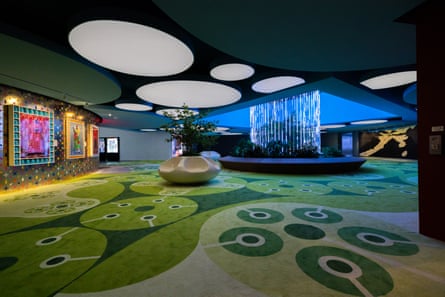
Throughout the spaces, museum objects (more than 1,600 from the 500,000-strong collection, supplemented by around as many loans) jostle with specially commissioned artworks, lavishly designed displays and interactive exhibits. The exhibitions are fuelled by wonder, spectacle and nostalgia – and are hard to resist.
Planes, engines, rockets – and a James Turrell
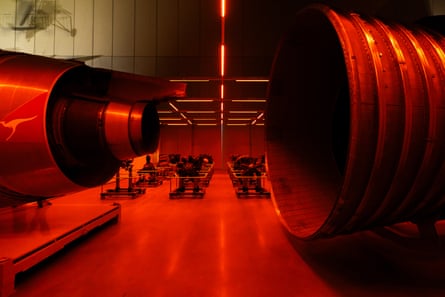
Task Eternal is Powerhouse Parramatta’s flagship opening exhibition – and the only one that adults will have to pay an entry fee for ($30/$20 concession; 16 and unders get in free). A celebration of flight and space travel, it takes over the museum’s main hall: 2,000 sq metres with 18-metre-high ceilings, bringing together objects from the Powerhouse collection as well as loans, commissions and literary texts – including excerpts from US science fiction author Ted Chiang, whose short story Tower of Babylon inspired the exhibition’s structure, including a zigzagging tower which visitors ascend and descend.
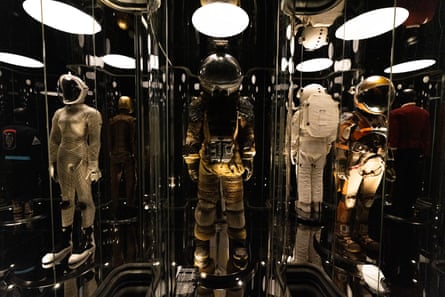
Hero items include delicate sketches by Leonardo da Vinci; a bumarang (boomerang) – an example of ingenious Indigenous aerodynamic design – collected from Burramatta/Parramatta in the early 19th century; a “boilerplate” (or testing model) Apollo command module from the 1960s; and the spacesuit worn by Leonard Nimoy’s Spock in Star Trek.
Aircraft from different eras, including the ingenious 19th-century flying rigs of Australian aviation pioneer Lawrence Hargrave, take pride of place. There is an entire room full of engines, and lots of rockets too, including a Skylark research rocket deployed at Woomera in the 70s, and a fully functional retro Rocket Playground from the 1960s.
Among the many stunning artworks, the star exhibit – at the top of the tower – is a perception-testing “ganzfeld” installation by US light artist James Turrell, accessible for those who bought a special Turrell-inclusive ticket ($40 for adults, $10 for kids). Eight viewers at a time are invited into a room with curved walls and a shifting cycle of coloured light, which induces the kind of disorientation experienced by pilots in certain altitudes and atmospheres.
Task Eternal is overwhelming in its scope and visual magnificence. It’s also a little discombobulating. Rather than chronology, it is structured around four “acts” exploring not only the history and technology of air and space travel, but our “cultural relationship with the sky” and “the human compulsion to ascend, leave Earth and return”. It zigzags between eras, topics and modes of storytelling; between science, engineering, design and art.
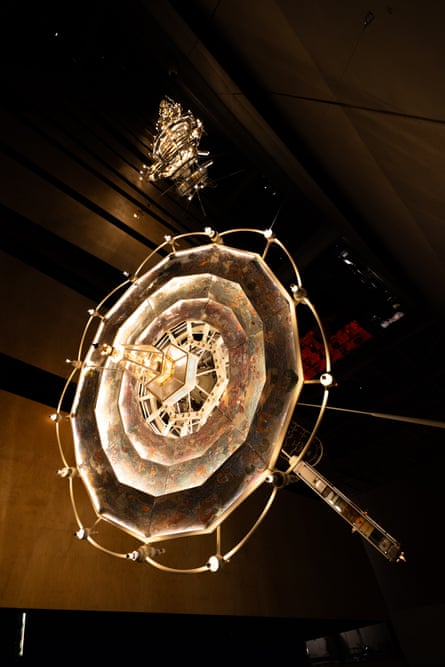
It also works hard to shed the western, patriarchal and colonial narratives around space and flight, and to weave in lesser-known histories and perspectives, including First Nations technologies and cosmologies. This doesn’t make for a smooth, coherent journey; though time, attention to wall texts and repeat visits may yield the kind of rich experience it aims for.
A secret playground that’s sure to be a hit
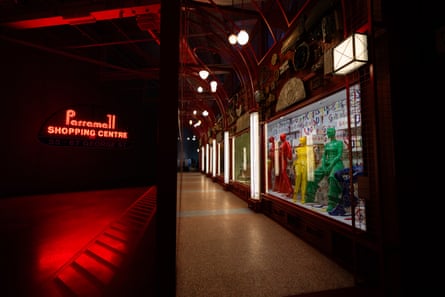
The Mall, a tribute to the social, cultural and design history of shopping centres, was only partially installed a week ahead of opening, but looks to be similarly maximalist. The Dark, the Powerhouse’s exhibition for children aged 4 to 12 set in a massive replica meteorite more than 22m long, will be an absolute hit – and not just because it’s top secret: no photographs are allowed, and visitors will have to bag their smartphones before entering.
We are allowed to describe how it works though: visitors enter via a dark, narrow tunnel followed by a series of glowing chambers, lined and stuffed with more than 800 objects, including sparkling minerals, retro toys, ancient artefacts and modern treasures (including the first item the museum collected, in 1882: a jar of peas). Part playground, part discovery trail, items are arranged from toddler to adult height, and there are enough hidden delights and nostalgic treats to thaw the most frosty heart – including animations drawing on First Nations creation stories, and the museum’s most Googled object: a heart-emblazoned shirt worn by Leonardo DiCaprio in Baz Luhrmann’s Romeo + Juliet. There’s not much narrative here, and some might grumble that it is light on science and learning, but museums desperately need to attract young audiences – and this might do the trick.
The calmest of the opening exhibits, titled Overflow, is an installation on the eastern building’s third floor: a 16-metre high-definition LED display of short films by director Ivan Sen, featuring breathtaking footage, each spotlighting one of seven Indigenous organisations from NSW who care for water, country and community.
In front of the screen is a shallow pool with water that laps with the tides of the river. Visitors are encouraged to take their shoes off and get their feet wet; there’s a sensorial magic about being 30m high, with your feet in the water and the sky on either side of you.
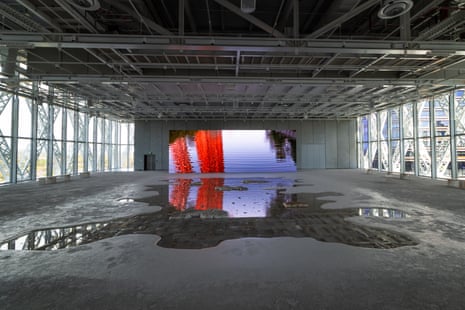
“We’re on a flood plain,” says Beau James, director of First Nations for the Powerhouse, gesturing to the Parramatta River out the window. In fact the location of the building was its own controversy for that very reason. “That river has always ebbed and flowed, that’s its natural way of moving. We wanted to honour water.”
As part of the commission, the museum invested an undisclosed amount of money in the organisations featured in Sen’s films. “We asked them: ‘What’s something you’ve always really wanted to do but have never been able to get funds for?’” says James.
The funded proposals include tagging marine life in Gamay (Botany Bay); clearing rubbish and mitigating pollution in the Parramatta River; and an initiative for clearing invasive European carp from the Barwon River in Brewarrina.
Es Devlin’s Australian debut
The final exhibition brings together recent works by British designer Es Devlin whose peripatetic career has encompassed theatre, fashion, public art and arena concerts (she has designed tours for Beyoncé, U2 and Lady Gaga, as well as Olympic ceremonies and Super Bowl half-time shows).
But Powerhouse’s exhibition – her Australian debut – sees Devlin in a more poetic and philosophical mode. Made over the last decade (and adjusted here for their Australian debuts), the five works, spread across four main rooms, represent Devlin’s attempts to use participatory art and interactive design to induce shifts of awareness and perspective; and to help rewire our sense of connection to the living world and each other.
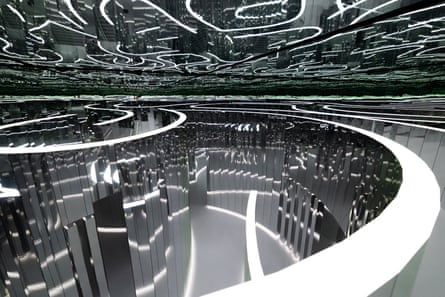
The visual highlight is a giant mirror maze, designed to represent the “arterial geometries of lungs and trees”. But the soul of the exhibition is the participatory work Collective Portrait: a room with a 24m table and an equally long, unspooling reel of white paper, with an invitation to sit down on either side of the table for 15 minutes and draw the person opposite you.
The point is not so much the drawing as the silent interpersonal exchange between strangers. “I’ve been practising this around the world, and I’ve found whoever I practise it with, it can be quietly transformational,” says Devlin.
She has also created a sixth, temporary work for the museum’s month-long opening festival: an Australian iteration of her 2022 outdoor work Come Home Again, featuring her own hand-drawn sketches of 244 endangered local species, and choral tributes which will be performed at dusk most nights through November within her illuminated outdoor installation on the Powerhouse’s riverside lawn.
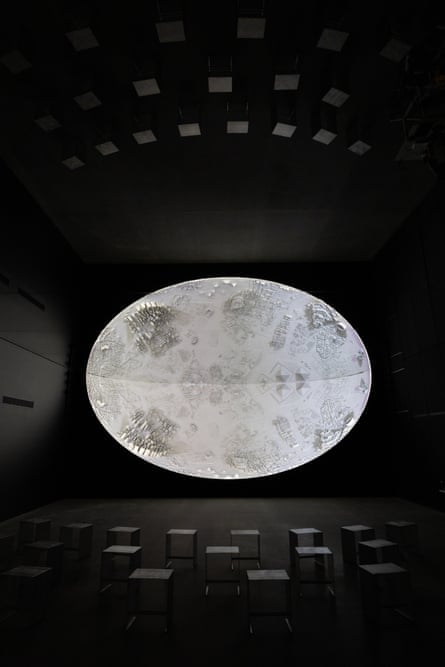
“I’m hoping that if we set up the rhythm of these evensong moments over the opening days and weeks, that people will continue to gather here. That it’s like a beacon.”
Devlin, who has exhibited in the world’s top galleries and museums, describes Powerhouse Parramatta as a “magnificent” building with “astounding” opening exhibitions. “The fact that people are going to not just learn things but feel things and therefore remember what they learned? I think it’s going to make it a destination for people to come from far and wide.”






 English (US) ·