.png)
Follow us
Add us as a preferred source on Google
Subscribe to our newsletter
quick facts
What it is: The head of the sassy Seagull Nebula (IC 2177)
Where it is: Between the constellations Monoceros and Canis Major, about 3,700 light-years away
When it was shared: Oct. 22, 2026
When a seagull stares you down, scientists recommend that you stare right back at it to keep your dignity (and your french fries) intact.
Two years ago, astronomers at the Vera C. Rubin Observatory put this idea — and their brand-new telescope — to a test of cosmic proportions, aiming an experimental 144-megapixel camera at the menacing blue eye of the Seagull Nebula (IC 2177).
Located about 3,700 light-years from Earth, the Seagull Nebula is a conglomeration of three giant, billowing clouds of irradiated gas. The "head" of the bird, featured in Rubin's image above, is a cloud called Sharpless 2-292. Its pink plumage is made of hydrogen gas, which glows brightly as ionizing radiation flies forth from the young stars at the cloud's center. The bird's blue "feathers" are clouds of dust reflecting the light from young, blue stars nesting elsewhere in the region.
It's unclear who won this stellar stare-down. If the bird appeared to blink, that's only because its eye is really the triple-star system HD 53367, a flickering trio of very young and energetic stars actively shaping the cloud around them.
The Rubin Observatory, meanwhile, had to avert its gaze quickly; this image is just one of about 16,000 exposures taken of the night sky between Oct. 24 and Dec. 11, 2024, according to the National Science Foundation, which co-manages Rubin along with the U.S. Department of Energy. Taken with the aforementioned Commissioning Camera (ComCam), the deep-space photos served as an early test of the observatory's hardware, software and image-processing capabilities.
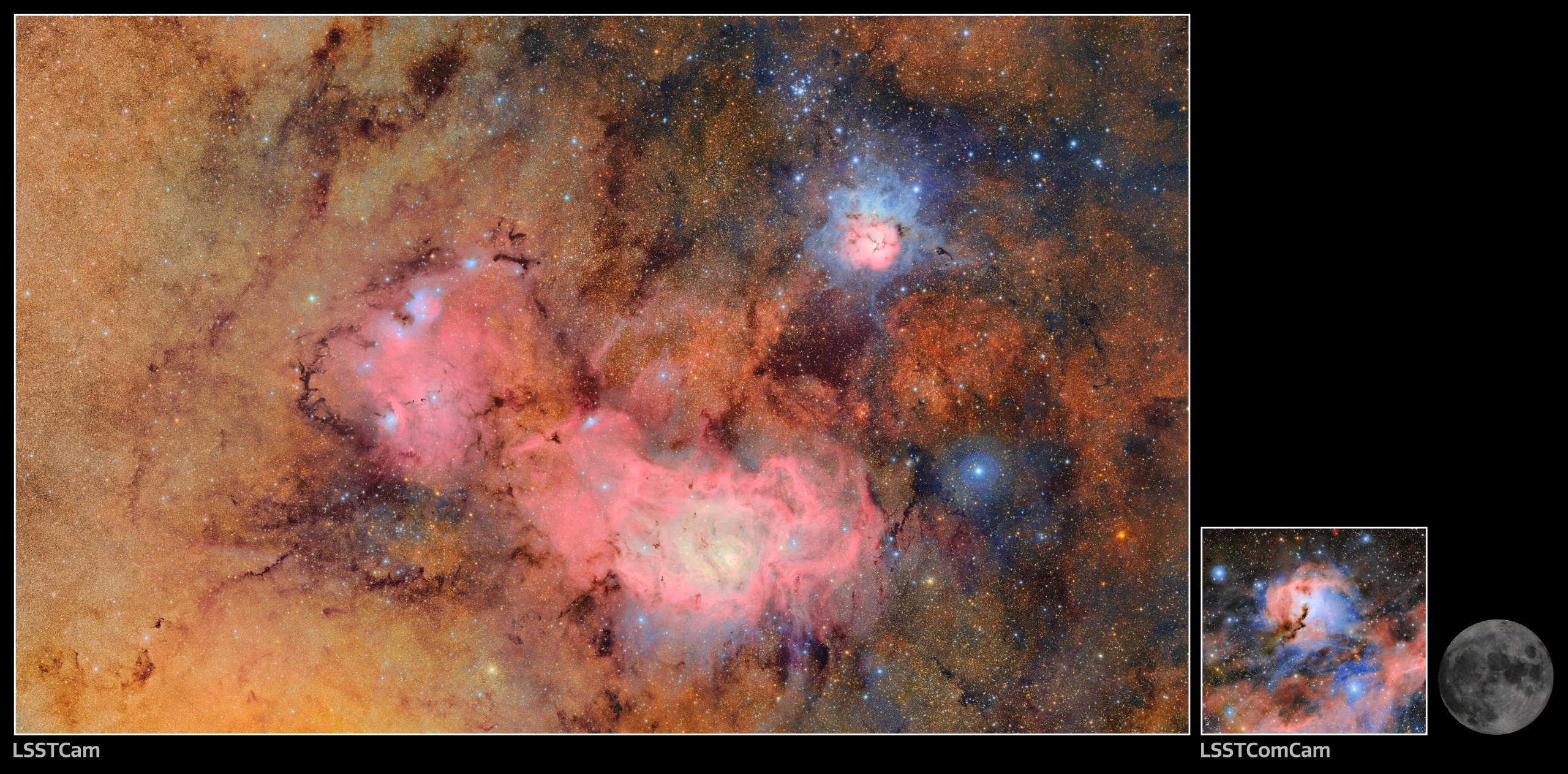
A comparison of ComCam's field of view (right box) with the LSST Cam's field of view (left box). The relative size of the full moon is shown for scale. LSST Cam, currently in use at the observatory, can see roughly 20 times more than ComCam saw in its test observations.
(Image credit: NSF–DOE Vera C. Rubin Observatory/NOIRLab/SLAC/AURA)
ComCam's test image is remarkably crisp — but what's even more impressive is that Rubin has since upgraded to a camera with more than 20 times the field of view. The Legacy Survey of Space and Time Camera currently mounted on the observatory's Simonyi Survey Telescope takes 3,200-megapixel images of the night sky every 30 seconds, completing a full scan of the entire southern sky every few nights, Tony Tyson, Rubin's chief scientist, previously told Live Science.
Now that the Legacy Survey of Space and Time has officially begun, Rubin will spend the next 10 years photographing the sky night after night, creating a time-lapse movie of the universe that is expected to reveal millions of cosmic wonders, from exploding supernovas to newfound comets and exoplanets. Perhaps it will even spot another bird.
Get the world’s most fascinating discoveries delivered straight to your inbox.
Like what you see? Take a look at the hidden details in the Vera C. Rubin Observatory's debut images here.







 English (US) ·